Poindexter™ by Glad Labs is an open-source, self-hosted AI content factory. It researches,
writes, reviews, and publishes long-form content on your own hardware — with a
human-in-the-loop approval queue and 13 QA rails that catch hallucinations
before anything ships.
Get up and running
From
git clone to your first generated post in about thirty minutes. Includes the bootstrap CLI, Docker stack, and a health-check walkthrough.Understand the architecture
The kernel/module/capability structure, the LangGraph pipeline, the three anti-hallucination layers, and how the pieces compose.
Operate it in production
Day-2 runbooks: incident response, backups, secret rotation, disaster recovery, and the CI/deploy chain.
Extend with plugins
Add a new Stage, Reviewer, Publishing Adapter, Tap, or Module — eighteen plugin entry-point groups, all step-by-step.
What is Poindexter?
Poindexter is a single-operator content engine. One person, one machine, a local Ollama install, and a Postgres database. The pipeline pulls topics from configurable sources, drafts with a writer LLM, reviews adversarially with a different LLM, runs 13 QA rails over the result, and hands you a queue of posts to approve from your phone. Everything tunable lives in theapp_settings table — no .env to babysit.
The engine is Apache 2.0. A separate Poindexter Pro add-on at
gladlabs.ai adds the operator console, the live
config seed from the production system (rebuilt weekly), and a long-form
book. Every prompt pack and Grafana dashboard ships free with the engine,
which runs fully without Pro.
By the numbers
13 QA rails
Cross-model critics, DeepEval (×3), native guardrails (×2), Ragas,
citation verification, vision QA — every post survives the gauntlet or
gets rejected.
60+ registered jobs
PluginScheduler boots taps, retention sweeps, memory hygiene, and content
surfaces on declarative DB rows. No hand-rolled cron.
18 plugin entry points
Tap, Probe, Job, Stage, TopicSource, LLMProvider, ImageProvider,
PublishAdapter, Module, and more — every surface is a registered
Protocol.
$0/month infra
Fully self-hosted. Ollama on your GPU, Postgres on the box, no paid API
in the critical path.
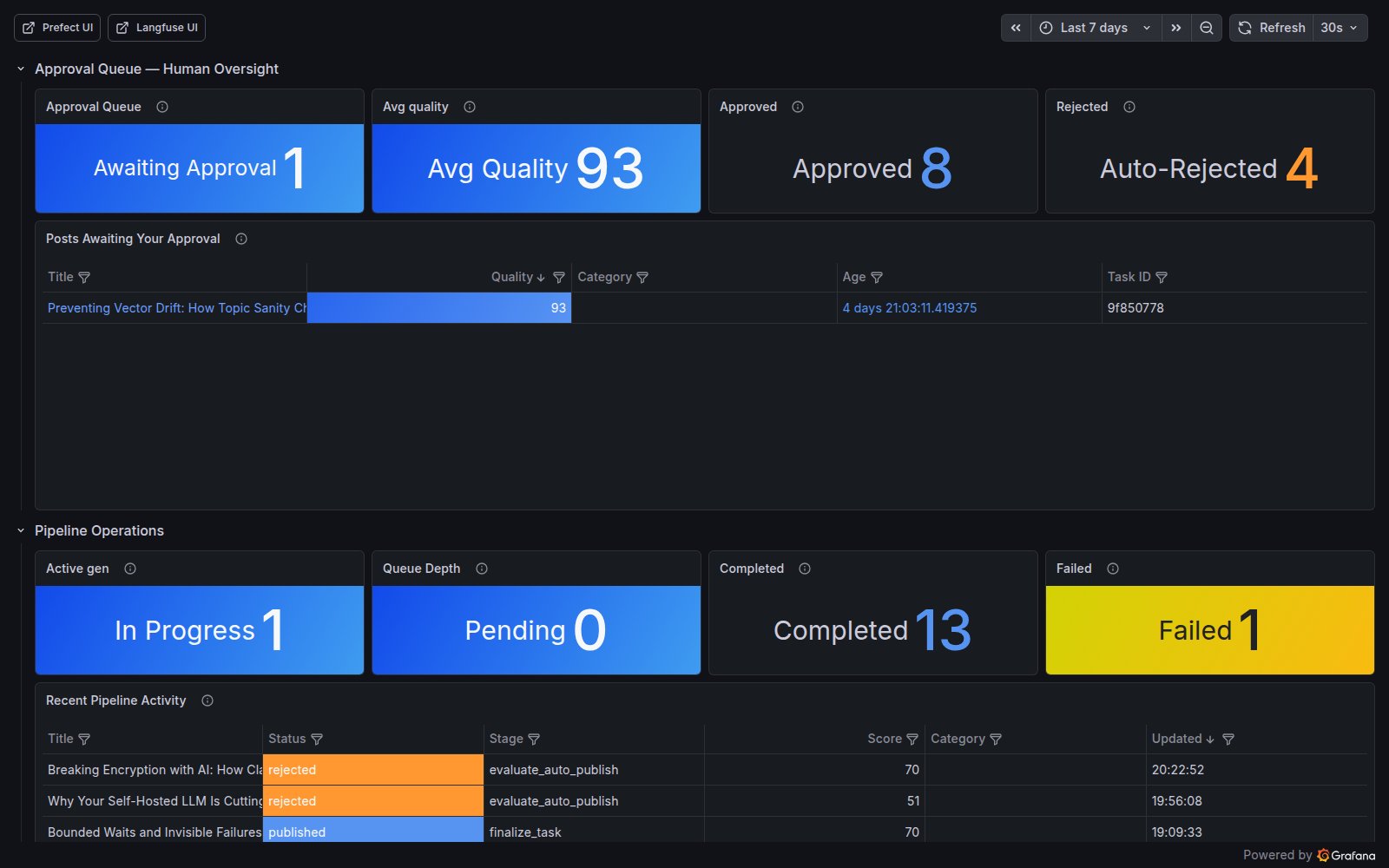
12 Grafana dashboards
Mission Control, Pipeline, Cost, Observability, System Health,
Integrations, QA Rails, Findings, Experiments & Dry-Run, Database,
Hardware & Power, and SEO Harvest — pre-provisioned.
44-node pipeline
canonical_blog graph_def: write → self-review → citation repair →
images → QA rails → SEO → media scripts → finalize.Contribute
GitHub
Issues, discussions, pull requests. Apache 2.0 licensed.
Contributing guide
How to set up a dev environment and ship your first PR.